The Choices That Made the Product Work in the Real World.
When building software, it is easy to default to standard tech patterns.
If you need to send alerts, you build an email integration. If you need to host data, you offer a local backup database option. If you need to design a user interface, you copy the layout of a popular US-based SaaS product.
But if you are building for a pharmacy counter or a busy clinic in a Tier 2/3 city in India, these standard patterns are recipe for a dead product.
Here are the three critical design decisions we made for Hospital Pharmacy OS, and why the trade-offs we chose are the only ones that make sense in the real world.
1. WhatsApp-First over Email & PDF Reports
Most business software compiles a beautiful daily PDF report and emails it to the owner at midnight.
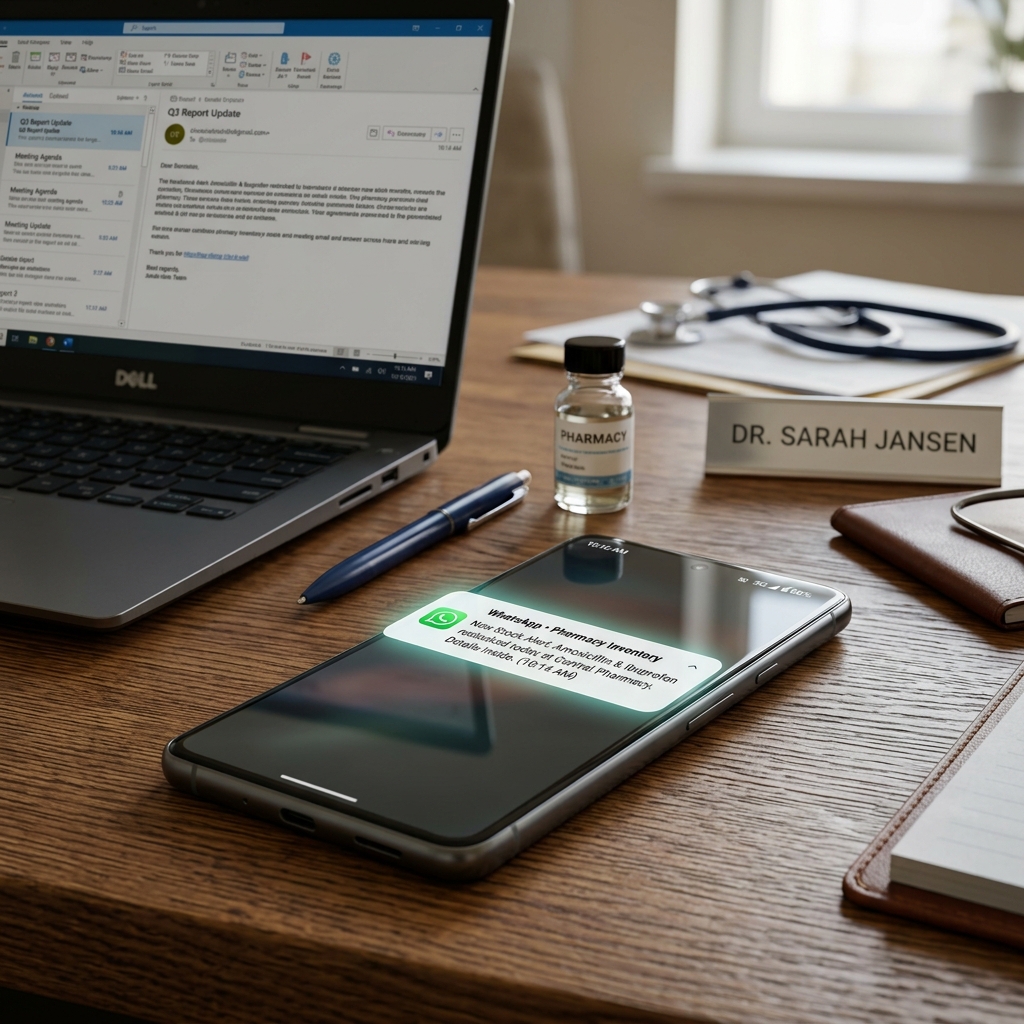
Here is the problem: small business owners do not live in their email inboxes. They do not log in every morning to read tables of data. But they check WhatsApp fifty times a day.
By routing critical inventory alerts, expiry warnings, and daily summaries directly to the owner's WhatsApp number, we put the information where their attention already is. The owner knows their counter’s performance without having to build a habit of checking a dashboard or opening an inbox.
2. Cloud-Native over Local Offline Installation
A common objection when building software for regional Indian businesses is connectivity. "The internet goes down, so we need local offline databases."
We spent months looking at this, and we decided to build Hospital Pharmacy OS as a cloud-native SaaS application. Here is why:
- Hardware is Fragile: If a local desktop computer breaks down or gets a virus, a local database is lost forever. Small operators do not run automated off-site backups.
- Maintenance is Non-Existent: Offline software requires updates to be manually installed via USB drives or remote access.
- Mobile Networks are Resilient: A local broadband line might go down, but 4G and 5G mobile networks are highly reliable. A cloud-native app can be accessed immediately from a phone or a tablet running on mobile data, keeping the counter moving.
3. Subscription over One-Time Licensing
The traditional model for local business software in India is a one-time license. You buy a CD-ROM or download a file, pay once, and own the software forever.
We rejected this model. We charge a monthly subscription because it aligns our incentives with the business owner:
- Continuous Support: One-time software is abandoned by the vendor the day the check clears. A subscription model means we are responsible for keeping the software running, secure, and compliant with changing GST regulations.
- Low Initial Cost: A subscription lowers the barrier to entry, letting a growing clinic adopt modern tools without a large, upfront capital layout.
Design decisions are not about what looks good on a Dribbble screenshot. They are about what survives the counter.
The choices we made for Hospital Pharmacy OS are the same principles we bring to all of our client projects at ThinkWare Labs. Whether we are building a custom web application or designing a database architecture, we look at the actual operational environment first.